

India Trip 2015 - Visiting the Mirtariqahmad Brothers
Our third and last day in Kashmir - we packed the car with all our luggage and squash into Sajad’s car. He has one last family he would like us to visit before we fly out midday. Travelling out from the city the roads begin opening up, lush fields, the sheer mountains peeking through the trees - but everywhere the effects of the flood waters still apparent - still a lush and beautiful drive.


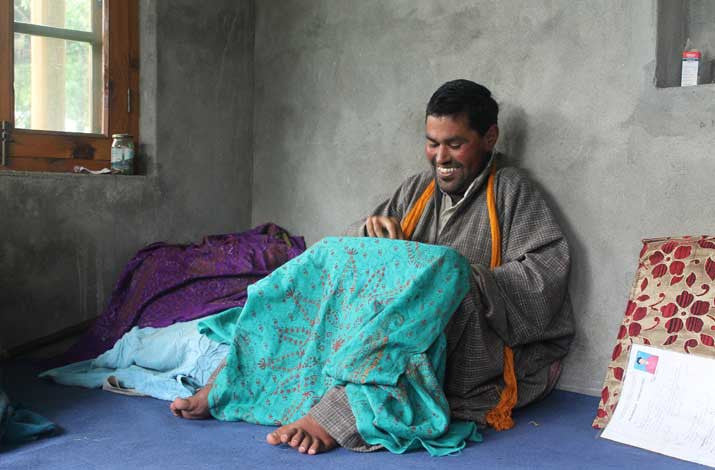
At the gate of the Mirtariqahmad house, we are met by the Father and the youngest brother, who walks with the aid of a walking stick. They take us into a room where the two older brothers are seated and stitching. While the effects of muscular dystrophy can be seen, it’s the warmth of their smiles that is striking and the speed of their hands as the stitch. We discover later - mobility is extremely difficult. The two older brothers basically do not leave the room and the younger brother does so rarely, and only accompanied.


In 2010, Kashmere University held an exhibition where disabled artisans could display their work. Shamlah, the designer from MESH, was there and so they were introduced. From there as Matthew put it ‘we have been travelling together.’ The partnership with MESH means that they can sell their products to a greater market, and get support - the middlemen at the local market do not give them a fair deal, taking the cream of their income. To sustain them the family has a farm planted within their house boundary, a cow, and also a small field which gives them rice - their field was damaged by the flood waters and their crops were ruined.
The fabrics come out and we get to see the exquisitely crafted embroidery. The range, detail and colour of the work is astounding. We see pieces that take from 20 days to 1 and half months.


We were able to create 5 designs based on existing patterns for Uplift Fair Trade products and these beautiful pieces are now available for purchase. Uplift is very grateful to be able to journey with these extremely talented artisans.

Leave a comment
Comments will be approved before showing up.
Also in Fair Trade Stories & Case Studies

The Wounds You Can’t See: Emotional Abuse, Manipulation, and the Courage to Speak Out
Emotional abuse is difficult to explain to others because there are no bruises. There’s no single event to point to. Instead, it’s a slow erosion of your self-esteem, your autonomy, and your confidence. It’s in the way you begin to question your own emotions, your own memories, your right to even feel.

When the world feels too big- Nepal and our response.
We don't have to fix everything
Maybe this is the thing I have needed to remind myself this week.
We don't have to fix what happened in Nepal.
We don't have to carry the enormity of everything that has happened.
But we can stand beside people we know and trust who are already doing the work.

Banana Fiber and how to care for it!
Discover Banana Fiber, an environmentally sustainable fiber we use in our knitwear collection from Nepal. Read about, what it is, why we use it and how to care for this beautiful blend of banana and wool. Handknitted into wonderful, jumpers, bennies, scarfs, cardigans, gloves and more for our winter collection.
Anna Spoore
Author